Guide
Alexa Routines: What Can Start One, and What Is Unconfirmed
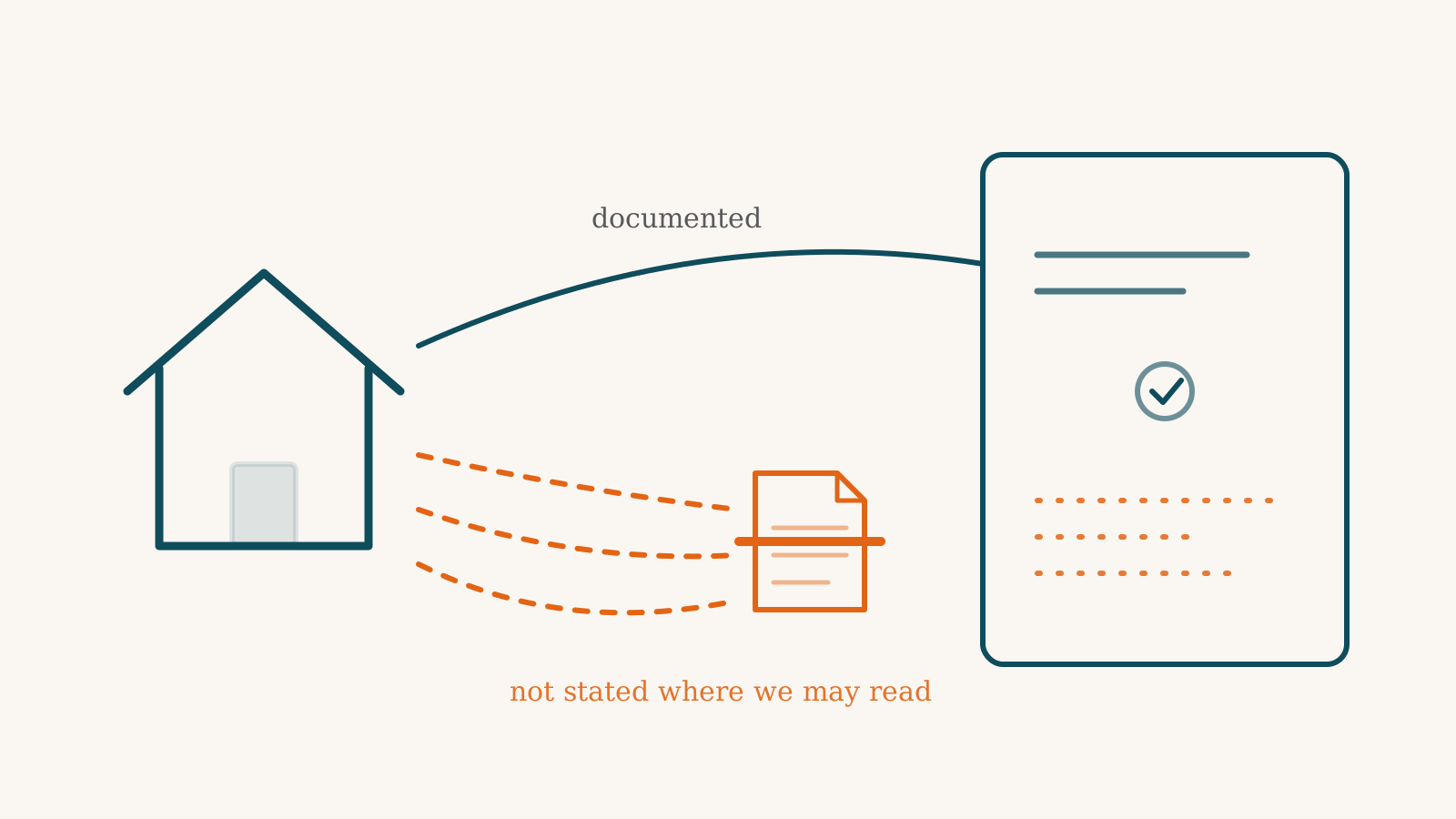
Of the 186 devices we track that work with Alexa, 88 have at least one ability that Amazon’s own writing puts within reach of a routine: a doorbell press, a motion sensor, a garage door reporting that it’s open, a camera spotting a person. Only 14 have an ability Amazon documents as out of reach, and every one of those joins over Matter. For 87 of them, what can start an Alexa routine is simply not documented anywhere we’re allowed to read.
Read “not stated” as a limit of the cited documentation, not a failed function. Amazon keeps its full list of routine starters and actions in its customer help pages, and those pages ask automated readers like ours not to read them. We respect that, so we don’t use them, their cached copies or other sites’ summaries of them. For most devices, “not stated” on Alexa means Amazon hasn’t said it anywhere we can cite. It does not mean Alexa can’t do it.
What Amazon has put in writing
Three kinds of Amazon writing are open to us, and together they answer the question for a short list of abilities.
Amazon’s developer site welcomes automated readers. Most of its pages describe how a device is controlled and never mention routines. Two are the exceptions. The doorbell page says Alexa uses doorbell events for “routines, and other use cases.” The button page says a press can trigger a routine, and its worked example is a routine that dims smart bulbs and closes the blinds. So dimming and opening or closing count as things a routine can do, not only things you can ask for by voice.
Amazon’s own news pages add more. They describe routines that run when a person or package is detected, when an alarm system is armed, and when a door opens. And the Alexa app’s list of routine starters, read on a set date, shows doorbell, person, package, motion, contact sensor, lock and security-mode starters. That list proves what exists. It can’t prove what’s missing, because a starter that isn’t offered for one device might still exist for another.
One detail from the app matters for cameras. On some cameras the person and package starters show as unavailable until the camera maker’s subscription is active. Amazon’s routine can use the detection. Whether your camera hands it over can depend on a plan you pay the maker for.
Put together, the starters with Amazon’s writing behind them are doorbell and button presses, motion and presence, open-or-closed contacts, a lock reporting whether it’s locked, a security system being armed or disarmed, and person and package detection. The actions are dimming and opening or closing. Everything else in the table rests on silence.
The numbers, by category
The tables below describe documented routine access for abilities listed on our product records. A platform-wide automation feature does not establish that a particular device sends it through its connection. Check the product profile for that condition.
Each table entry is one ability of one device, marked with the same three labels our product pages use. "✓ routines can use it" means Amazon’s writing, or the maker’s, puts it within a routine’s reach. "✗ app only" means Amazon publishes a list that claims to be complete and the ability isn’t on it. "? not stated" means nobody has said either way where we can read it. The three are not a scale. The second is a finding and the third is a gap.
| Products | ✓ routines can use it | ✗ app only | ? not stated |
|---|---|---|---|
| 186 | 119 | 20 | 351 |
| Category | Products | ✓ routines can use it | ✗ app only | ? not stated |
|---|---|---|---|---|
| Smart Lighting | 26 | 21 | 4 (Scene) | 72 |
| Switches & Dimmers | 18 | 8 | 0 | 25 |
| Plugs & Outlets | 16 | 0 | 8 (Energy monitoring, Energy reading, Scene) | 26 |
| Cameras & Doorbells | 18 | 31 | 3 (Motion detected, Package detected, Person detected) | 68 |
| Smart Locks | 11 | 9 | 0 | 13 |
| Thermostats | 11 | 1 | 0 | 43 |
| Hubs & Controllers | 4 | 1 | 0 | 6 |
| Sensors & Detectors | 15 | 14 | 0 | 8 |
| Smart Pool | 2 | 0 | 0 | 9 |
| Security Systems & Alarms | 5 | 3 | 1 (Arm/disarm) | 2 |
| Water Protection & Plumbing | 8 | 0 | 1 (Leak detected) | 11 |
| Garage & Access | 11 | 18 | 2 (Contact state, Open/close) | 1 |
| Blinds, Shades & Curtains | 10 | 9 | 0 | 5 |
| Robot Vacuums & Mops | 8 | 0 | 0 | 11 |
| Indoor Air & Comfort | 11 | 4 | 1 (Fan direction) | 30 |
| Energy, Solar & EV | 3 | 0 | 0 | 5 |
| Outdoor, Lawn & Irrigation | 9 | 0 | 0 | 16 |
- Energy monitoring — ✗ app only · Alexa — Matter path
- Energy reading — ✗ app only · Alexa — Matter path
- Fan direction — ✗ app only · Alexa — Matter path
- Leak detected — ✗ app only · Alexa — Matter path
- Scene — ✗ app only · Alexa — Matter path
Sources: Amazon Alexa — automation engine ceiling (eight terms observed; residue inconclusive by refusal) (read 2026-09-01) · Alexa — Matter path (read 2026-09-04)
Across all of it, 119 abilities are marked as usable, 20 as app only and 351 as not stated. Garage-door controllers lean furthest toward usable, with 18 abilities marked usable against 1 not stated. An opener is mostly an open-or-closed reading and an open or close action, and Amazon’s writing backs both. Cameras and doorbells split: doorbell presses and, on most, motion are usable, while live video, two-way talk and pet, vehicle and face detection are not stated. Plugs sit at the other end. Switching a plug on or off is the one thing a plug does, and no page open to us describes a routine doing it.
That last point looks odd and deserves a plain answer. Plain on and off, across lights, plugs and switches, is marked not stated on Alexa. It is a gap in what we can cite, not a sign that a routine can’t switch a plug.
What Amazon documents as out of reach
Amazon’s pages that we can read never say an ability is outside a routine’s reach for every device. An out-of-reach finding needs a complete list that leaves the ability off, and the complete list is the one we can’t read. So we don’t manufacture negatives from silence.
Over Matter there is such a list. Amazon’s Matter page names the categories Alexa supports and maps each Matter feature to an Alexa one. 5 kinds of ability we track fall outside that mapping, and on Alexa they are app only over Matter.
Energy readings have nowhere to land. Amazon’s list has no electrical-measurement category, so a Matter plug’s power reading reaches no Alexa feature. The Eve Energy, IKEA GRILLPLATS Smart Plug and Tapo P210M in-wall outlet all track energy use, and over Matter that reading can’t start or steer a routine.
A Matter leak sensor maps to nothing. Amazon’s sensor table lists the water leak detector and leaves the Alexa feature column empty. The IKEA KLIPPBOK Water Leak Sensor joins Alexa over Matter, and its leak alarm is app only there. Our Matter automation story covers what the Matter lists leave out on every platform.
Scenes stored on the device aren’t in Amazon’s Matter mapping either, which affects devices like the GE Cync Outdoor Smart Plug, the Nanoleaf Matter Multicolor HD Lightstrip and the Tapo P400M outdoor plug.
Where nobody says
351 abilities in the table are marked not stated. For most of them Amazon doesn’t document it either way on any page we’re allowed to read. Over Matter, Amazon’s Matter page lists the kinds of device Alexa supports. Where Amazon’s routine writing also covers an ability, we mark it usable as Amazon’s rule for that kind of device, never as a finding about one model. Motion, a contact sensor, a button press, a lock’s state, dimming and blinds opening and closing are in that group. Switching on and off, color, thermostats and most readings stay not stated over Matter, because the routine writing we can read doesn’t cover them on any route.
For some devices the silence is the maker’s. The manufacturer doesn’t document this: August’s Alexa page lists voice commands for locking, unlocking with a PIN and checking status, and says nothing about routines. Wyze’s integrations page, written for its whole range, describes asking Alexa to show a camera’s live feed, and the page for the Wyze Cam v4 names Alexa without saying which features come across. Aqara’s page for the Aqara G5 Pro writes every automation example for Aqara’s own app. Voice control and routines are different things, and a maker page that covers only the first leaves the second open.
Locks show how the two kinds of silence stack. The Schlage Encode Plus has locking marked usable, because Schlage’s own page puts “lock the door” inside a routine and describes unlocking as a voice feature that’s off by default. The Aqara U200 and Aqara U400 come in over Matter, and the August Wi-Fi Smart Lock has a maker page that covers voice only. Locking is marked not stated on all three. Door sensors split along the same route line, and our door sensor guide walks through the routes for the ones we cover. For cameras on every platform, see our camera automation guide.
Before you buy for automations
- Check the route, not just the badge. Each product page shows how the device reaches Alexa. Over Matter, a usable mark is Amazon’s rule for that kind of device, and the product’s own Matter support still decides whether the ability comes across. On other routes it rests on a maker’s skill, a cloud link, a hub or bridge, or a direct connection.
- For doorbells and cameras, the documented starters are the doorbell press, motion and, on some cameras, person and package detection. Check whether the maker needs a subscription before those reach Alexa.
- For energy-based routines, such as switching something off when it stops drawing power, a Matter plug’s reading reaches no Alexa feature. Look at what the plug’s own app can do.
- For Matter devices, you need a Matter-capable Amazon Echo or eero device to add them to Alexa at all.
- For locks, plan on routines that lock. Our cited records do not establish routine-based unlocking; voice unlocking is a separate function.
To see which devices in a category work fully with Alexa, start from a list. There is one each for lighting, cameras and doorbells, plugs, hubs and switches. There are also lists for locks, thermostats, blinds and shades and sensors. If you already know the devices you want, the compatibility checker shows how each one connects.
What would change this answer
More published documentation could change these answers. If Amazon’s routines help pages stopped turning away automated readers, or Amazon published the same list on its developer site, most of some currently unconfirmed functions could be checked. The trend so far runs the other way: in May 2026 Amazon retired the developer kit for custom routine triggers.
Smaller changes move single rows. A maker writing down that its device can start an Alexa routine is what turns a not stated cell usable. Arlo does it for one of its cameras, with step-by-step setup for a routine that starts on the camera’s motion. Amazon adding categories to its Matter list, or saying outright that Matter devices can join routines, would answer the Matter rows together. And a device moving between Matter and a skill or cloud link moves its row.
We read Amazon’s developer pages on routines on 2026-09-01 and its Matter categories page on 2026-09-04. Both are due for a scheduled re-read by early next year, and the first check at that re-read is whether Amazon’s help pages have opened to automated readers. The figures on this page are recomputed from our product records every time the site is built.
Frequently asked questions
Why does so much of the Alexa table say not stated?
Amazon lists what can start a routine, and what a routine can do, in its customer help pages. Those pages ask automated readers like ours not to read them, and we respect that, so we don't use them or copies of them. What Amazon has published where it welcomes automated readers covers only a handful of abilities. For everything else the honest answer is that it isn't documented anywhere we can cite. That is a gap in what we can show you, not a finding that Alexa can't do it.
Can a Matter device start an Alexa routine?
Amazon's Matter page lists the kinds of Matter devices Alexa supports and the Alexa feature each one maps to. Some abilities are covered twice: the kind of device is on that list, and Amazon's routine writing covers the ability. Motion and contact sensors, button presses, a lock reporting its state, dimming and blinds opening and closing are among them. Our tables mark those usable as Amazon's rule for that kind of device. That is not a test of one model, and a product's own Matter support can still hold it back. Most other Matter abilities stay not stated, because nothing Amazon publishes where we can read it covers them in routines. A few Matter readings, such as energy use and water leaks, have no place in Amazon's Matter list, and those are app only. Adding a Matter device also needs a Matter-capable Amazon Echo or eero device.
Can an Alexa routine unlock my door?
Nothing we can read says so. Schlage's own Alexa page puts locking the door inside a routine and describes unlocking as a voice feature that is off by default. August's Alexa page covers voice commands and says nothing about routines either way.
Sources for this guide· 5 sources and 5 product records
Product facts come from the linked research records; other cited sources appear below. Read each claim with its source date and any stated limit. Prices, features and support can change after a check. These are research profiles, not hands-on reviews.Report a correction if a source now gives a different answer.
- Amazon developer docs: Alexa.DoorbellEventSource — as of 2026-09-01
- Amazon developer docs: Alexa.SimpleEventSource — as of 2026-09-01
- Amazon developer docs: supported Matter device categories — as of 2026-09-04
- Amazon developer docs: connect your device to Alexa with Matter — as of 2026-09-11
- Alexa app: the routine starter list — as of 2026-09-06
- GE Cync Paddle Dimmer Smart Switch (Matter) — record last verified 2026-09-27 · 33 sources, cited in full on its profile
- GE Cync Full Color PAR38 Smart LED Light Bulbs, 2-Pack (93129693) — record last verified 2026-09-18 · 10 sources, cited in full on its profile
- Govee 21-Inch Smart Ceiling Light Ultra — record last verified 2026-10-16 · 40 sources, cited in full on its profile
- Amazon Echo Dot (5th Gen, 2022 release) — record last verified 2026-09-29 · 31 sources, cited in full on its profile
- Arlo Pro Security Camera 2K (6th Gen) — record last verified 2026-09-23 · 22 sources, cited in full on its profile