Presence Sensor vs Motion Sensor: What mmWave Radar Changes
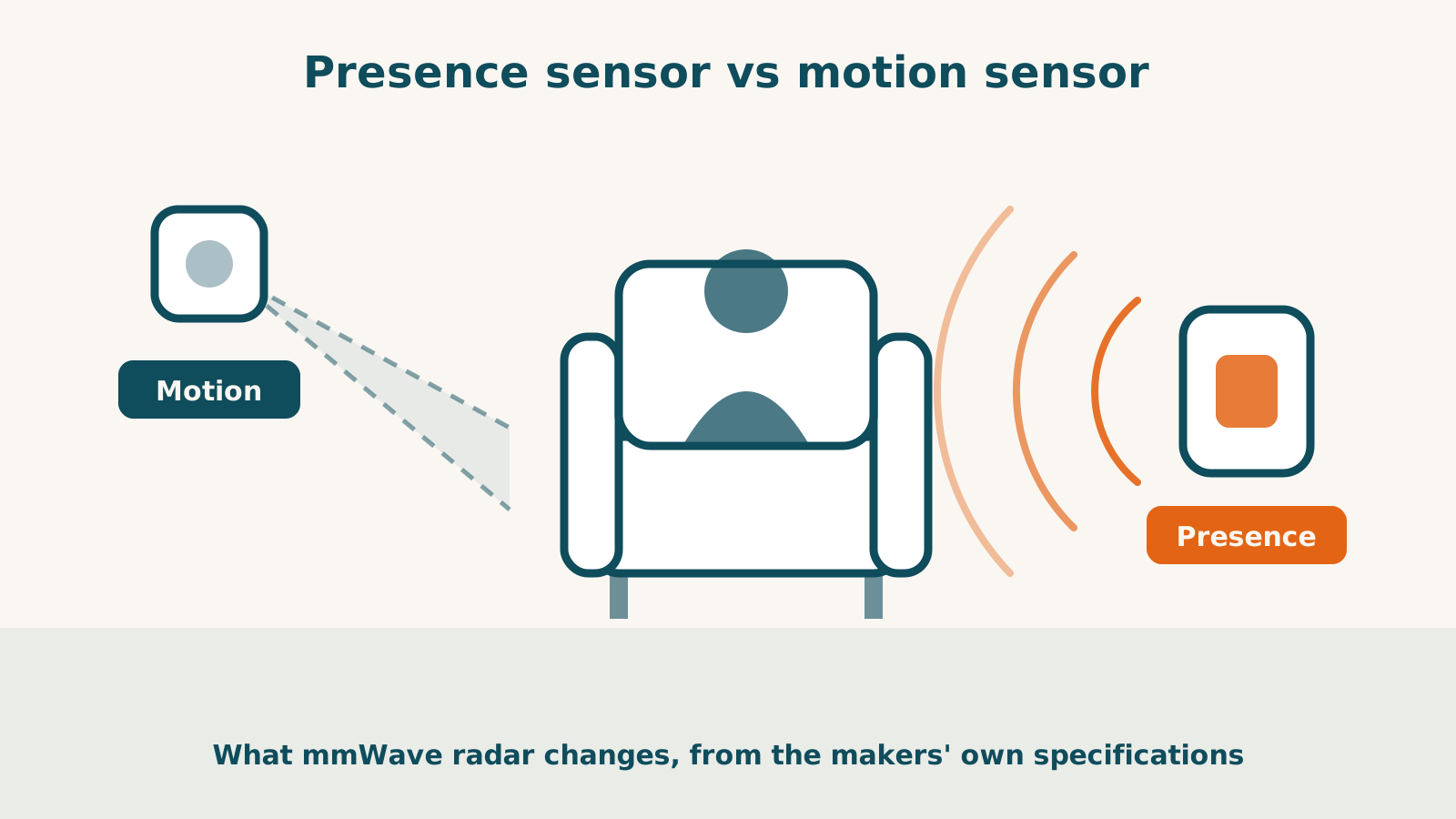
If your lights go off while you’re sitting still at a desk or reading on the sofa, the sensor that switched them off is doing what motion sensors do. It noticed you arrive, saw no movement for a while and decided the room was empty. A presence sensor using mmWave radar is designed to keep reporting a person who hasn’t moved. THIRDREALITY’s own range shows the split: it sells the R2 with 24 GHz mmWave radar as a presence sensor, and a separate, cheaper “USB Motion Sensor” that uses PIR.
That one difference is why presence sensors exist. What the makers publish about them shows what you give up to get it.
What each type is good at
A motion sensor answers “did something just move?” That’s the right question for a hallway, a stair, a porch or a pantry, where anyone who is there is moving. It’s the wrong question for a room where people settle.
A presence sensor answers “is someone here?” The clearest published sign of that is SwitchBot’s: it gives its Presence Sensor a separate detection range for people who are standing or sitting still. Our records place the Meross MS600 and the Aqara FP2 in the same rooms, the desks, sofas and reading chairs where motion sensors switch the lights off on people.
Two of the four don’t rely on radar alone. SwitchBot pairs 60 GHz radar with a PIR sensor and a light sensor, and Meross pairs PIR with 24 GHz radar. The FP2 uses 60–64 GHz radar, and THIRDREALITY’s R2 uses 24 GHz radar.
Power is the first trade-off
Two of the four presence sensors in our library need wall power all the time. The other two run on ordinary batteries.
| Sensor | Power | Maker’s stated battery life |
|---|---|---|
| Aqara Presence Sensor FP2 | USB-C, constant power | none, wired only |
| Meross MS600 | USB-C, “requires continuous power” | none, wired only |
| SwitchBot Presence Sensor | 2 × AAA | up to 2 years |
| THIRDREALITY R2 | 3 × AA | up to 3 years |
SwitchBot credits its two-year figure to an ultra-low-power radar. THIRDREALITY pitches the R2 for “hallways, bathrooms, cabinets, storage rooms, and other areas where wired power is inconvenient”. Both figures are the makers’ own. A plugged-in sensor needs a cable reaching every spot you want covered, which Meross itself flags as the constraint to plan around.
Battery motion sensors look much the same on this measure. The Philips Hue Motion Sensor is rated for a minimum of two years on two AAA cells, and the Aqara Motion and Light Sensor P2 up to two years on two CR2450 coin cells.
Radar can see things that aren’t people
A sensor sensitive enough to notice someone breathing in a chair can also notice other movement. THIRDREALITY publishes this limit rather than leaving you to find it. Its environment learning “helps reduce false triggers from everyday background movement, such as airflow or slight curtain movement.” But “strong or repetitive motion, such as fans, may still trigger detection.” A presence sensor pointed at a ceiling fan can go on reporting someone after the room has emptied.
The same maker says the R2 detects through “common non-metallic materials such as wood and glass”. That helps if the sensor sits inside a cabinet. It also means the space it watches may not stop where the room does. The other three makers don’t address either point in what our records hold, so treat placement away from fans, vents and moving curtains as something to check rather than assume.
Range and zones
The makers’ figures differ widely, and they aren’t measured the same way:
- Aqara FP2: up to 15 metres. Aqara says a room of up to 40 m² can be divided into zones, and presence in each zone can trigger a different automation. The zones are drawn and kept up to date in the Aqara app.
- Meross MS600: a 12-metre, 360-degree range.
- SwitchBot Presence Sensor: 8 metres for moving people and 5 metres for still ones, across 120 degrees.
- THIRDREALITY R2: roughly 1 to 5 metres, with five sensitivity levels.
SwitchBot’s split between moving and still is worth noticing: for that sensor, the range for a still person is 3 metres shorter than the headline figure. The other makers don’t publish the distinction, so their single figure may not tell you how far a seated person will be seen.
What your platform receives
This is where a presence sensor can lose most of its point. Buying one only helps if your platform can use “someone is still here” in an automation.
- The FP2 reaches Apple Home over HomeKit as several sensors, one per zone plus a light sensor, and Home Assistant receives the same. Aqara’s own table gives Alexa and Google Home multi-zone presence without the light sensor.
- The SwitchBot Presence Sensor needs a SwitchBot hub for every voice platform and for Apple Home. SwitchBot also documents that Google Home can’t use it as an automation condition. Home Assistant can reach it over Bluetooth with no hub.
- The THIRDREALITY R2 needs a Zigbee hub. THIRDREALITY names Home Assistant, SmartThings, Hubitat, Homey, Aeotec and Echo devices with a built-in Zigbee hub, and names no Apple Home or Google Home route.
- The Meross MS600 reaches Apple Home, Alexa and Google Home through Matter over Wi-Fi, and Meross says both the presence and light sensors appear in Apple Home. SmartThings and Home Assistant aren’t named, so we treat both as unknown.
Matter adds a wrinkle of its own. It carries motion and occupancy in the same kind of report, and Google’s Matter device list shows one Occupancy Sensor type rather than two. A Matter presence sensor and a Matter motion sensor can look alike to the platform. Whether the platform then uses the report in automations is a separate question, covered in our look at what Matter lets each platform automate.
Which one fits the room
- Hallways, stairs, entrances, closets: a motion sensor. People passing through are moving, and a battery motion sensor avoids the power and false-trigger trade-offs.
- An office, a reading chair, a bathroom: a presence sensor. If there’s no outlet within reach, the SwitchBot and THIRDREALITY models are the battery options in our library, each with its own hub requirement.
- A room with a ceiling fan or a vent that moves curtains: presence detection is where the R2’s maker warns of false triggers, so plan the sensor’s position before buying.
- An Apple Home household without a SwitchBot or Zigbee hub: the FP2 (over HomeKit) and the MS600 (over Matter) are the presence sensors whose makers name Apple Home without either of those hubs. Matter accessories in Apple Home still need an Apple home hub such as a HomePod or Apple TV.
Our smart sensor directory lists every motion, presence and contact sensor we cover, with the hub each one needs before it works.
Frequently asked questions
Does a presence sensor replace a motion sensor everywhere?
No. The presence sensors in our library either need constant USB power or a separate hub. One of them also has a false-trigger problem its own maker describes: fans and other repetitive movement can make it report a person who isn't there. In a hallway or on a stair, where people are always moving, a motion sensor does the job the presence sensor was built for without those trade-offs.
Will Apple Home or Google Home show the difference between motion and presence?
Not necessarily. Over Matter, motion and occupancy share one type of sensor report, and Google's list of supported Matter devices does not separate the two. What your platform receives is decided by the sensor's own connection, which is why the platform notes on each product page matter more than the words on the box.
Can a radar presence sensor see through walls?
THIRDREALITY says its R2 detects through common non-metallic materials such as wood and glass. None of the other presence sensors in our library makes that claim either way. Read it as a placement consideration as much as a feature: a sensor that sees through a cabinet door can also see movement in the next space.
Sources for this guide· 1 source and 6 product records
Product facts in this guide come from our provenance-tracked research records — every claim traces to a named source with the date we verified it. Dates matter: ratings, prices, certifications, and compatibility can change after we check them, so read anything time-sensitive as true as of the date shown, not guaranteed current. Spot something stale? Tell us and we'll fix it.
- Google: Supported Matter device types — as of 2026-09-04
- Aqara Presence Sensor FP2 — record last verified 2026-08-08 · 20 sources, cited in full on its profile
- SwitchBot Presence Sensor — record last verified 2026-09-15 · 22 sources, cited in full on its profile
- THIRDREALITY Smart Presence Sensor R2 — record last verified 2026-09-18 · 11 sources, cited in full on its profile
- Meross Matter Smart Presence Sensor (MS600) — record last verified 2026-08-31 · 8 sources, cited in full on its profile
- Philips Hue Motion Sensor (indoor) — record last verified 2026-08-09 · 14 sources, cited in full on its profile
- Aqara Motion and Light Sensor P2 — record last verified 2026-08-08 · 21 sources, cited in full on its profile