The Wemo Shutdown: Which Plugs Kept Working, and What Decided It
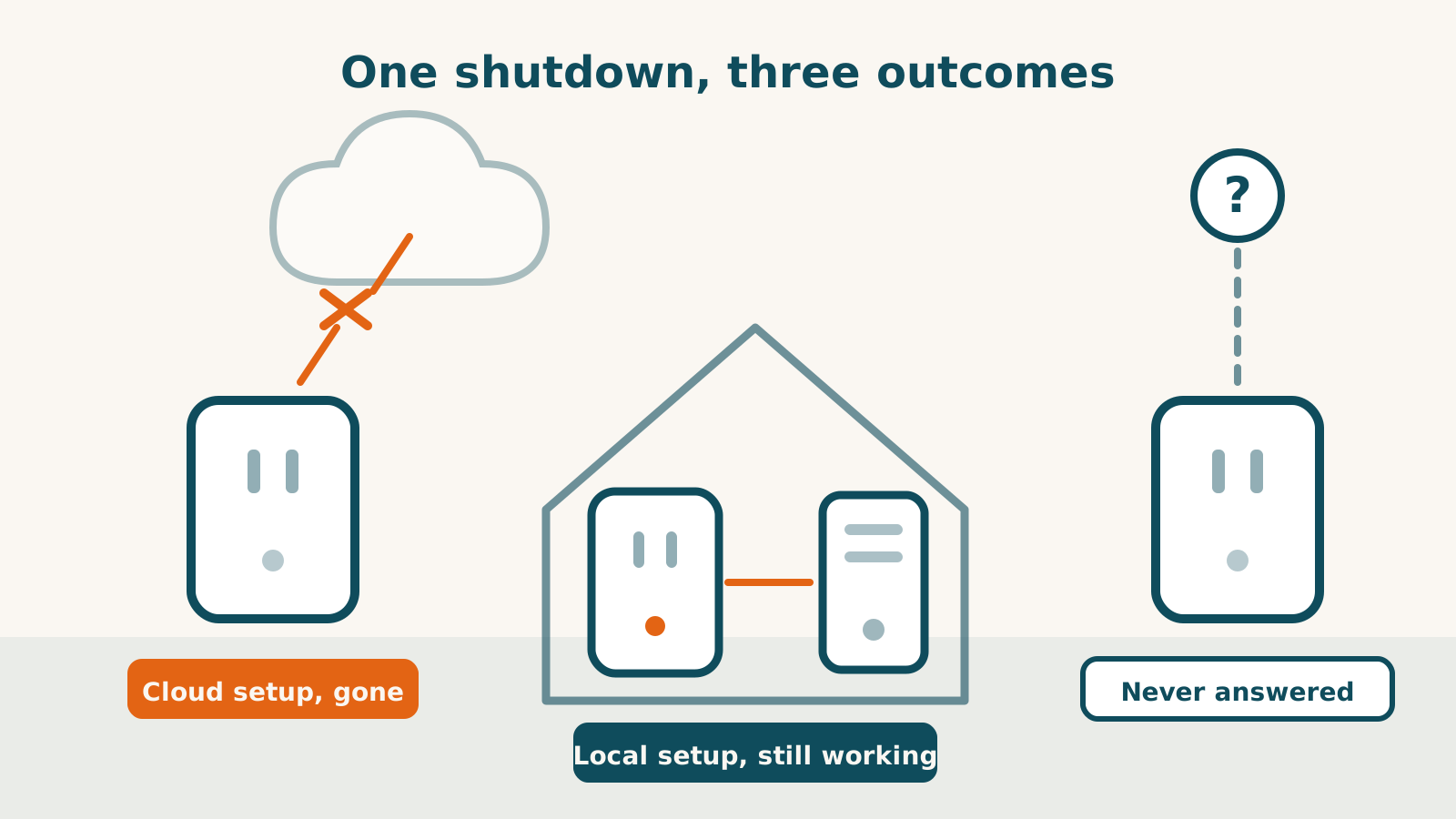
Belkin switched off the Wemo cloud on 31 January 2026, and the plugs in people’s walls did not all fail together. Some lost every smart function. Some carried on working inside the house and lost only remote access. One model was listed as unaffected. What separated them was not price or age. It was how each plug had been connected in the first place.
That makes the Wemo line an unusually clear record of what a cloud shutdown does to hardware, and a useful thing to hold up against whatever plug you are about to buy.
What Belkin documented
Belkin’s end-of-support article set a date and a list, and our record follows it. Three outcomes came out of the same shutdown.
- Wi-Fi models with no Apple Home support lost everything smart. The app, remote access and the Alexa and Google Assistant links all ran through the Wemo service, and all of them stopped.
- Apple Home capable models kept local control, if they were already set up. Belkin lists the WSP080, WSP090 and F7C063 among products that continue to work through Apple Home, provided they were configured before the cutoff date. That is Apple Home over HomeKit rather than Matter, and it is local, so it needs no Belkin service at all.
- The Thread-based WSP100 was listed as unaffected.
The sharpest consequence is for anyone shopping. New Apple Home setup is no longer possible after the cutoff, and the app that did Wi-Fi setup is gone, so a boxed Wemo plug bought today cannot be configured. Belkin’s own table also shows how long some of that stock has been sitting: the column is headed “Last Sold Units Date”, and the WSP080 row reads November 2023.
Belkin did publish an exit route. Units still under warranty on or after 31 January 2026 may be eligible for a refund with proof of purchase, claimed through the Wemo end-of-support form, and Belkin recommends authorised recycling for units that no longer work.
The question Belkin never answered
Home Assistant is the one cell in our Wemo record that still reads unknown, six months on, and the reason is worth stating.
Home Assistant’s own Wemo integration is documented as working over your home network with no cloud involved, and it is still shipped and documented today with no notice that it is going away. Belkin’s shutdown notice says nothing about whether a plug’s local control survives. In July 2026 an owner reported Wemo devices that had been working until a Home Assistant update and then stopped responding while still on the network, which points at the update rather than at Belkin.
One report does not settle a compatibility answer. So our record says unknown, rather than promising owners something we cannot show.
What actually decided who kept control
Strip the model numbers away and one thing separates the survivors: where the pairing lived.
Belkin documented both routes into this plug, and the difference between them is the whole story. Setting it up in the Wemo app required a free Wemo account. Setting up the same plug in Apple Home took five steps that never mention Belkin at all. Plug it in, wait for the light to blink, open the Home app, add the accessory, then scan the code printed on the quick start guide in the box. One route put Belkin in the middle. The other did not.
A plug set up through a manufacturer’s account is reachable because that company’s servers are running. When the servers stop, the pairing has nowhere to resolve, which is why the non-Apple Wemo models went quiet on a scheduled date rather than breaking.
A plug commissioned locally, through Apple Home or over Thread, is paired to equipment in your house. The manufacturer is not in the path for day-to-day control, so its exit does not reach the light in your living room.
Neither route protects the extras. The app goes when the company goes, and so does anything stored only in it.
How that reads on plugs sold today
Our library records the setup route for each plug, and the spread is wide.
- Eve Energy is the clearest case of the local design. Eve states that it runs no cloud service behind the plug at all, and no account is needed. The risk moves to whichever platform you commission it into. The cost is equipment: it is Thread rather than Wi-Fi, so it needs a Thread border router and a Matter controller before it does anything.
- IKEA GRILLPLATS is the only product in our plug records where the maker has written down what happens afterwards. IKEA commits to continued local operation after software support ends, and the commitment is conditional: it covers a plug paired with a DIRIGERA hub or a TRÅDFRI gateway, not one running under another company’s Matter controller.
- Tapo P125M sets up over Matter without a TP-Link account, per TP-Link’s own setup documentation, and control is local from there.
- Leviton D215R shows how a single product can sit on both sides. Leviton documents an Apple Home setup path that names no Leviton account, and states that voice control through Alexa or Google Assistant requires setting the device up with its My Leviton service. Same outlet, two very different dependencies.
- Kasa HS300 is the opposite end. A TP-Link account is required, Alexa and Google both run through TP-Link’s service, and there is no Apple Home route. Home Assistant controls it locally, and even that path wants your TP-Link credentials to authenticate.
- Amazon Smart Plug documents its own walls. Amazon states it “works exclusively with Alexa” and “does not support other voice assistants or smart hubs”. We searched Amazon’s own pages for a support period or an end-of-updates date and found none, so our record carries that as a checked absence rather than an unexamined field.
Shutdowns are usually partial
Whole-service closures are rare. Features being withdrawn is not.
On 1 August 2026 TP-Link ended support for the automation service IFTTT across its Tapo and Kasa products, naming the affected models on its own list. The Tapo P125M and the Kasa HS300 are both on it. The plugs themselves are unimpaired, every platform integration still works, and local control was untouched. What went was the cross-vendor glue: a household that bought one of these to drive an automation in a third-party service lost that, and the maker’s own app does not replace it.
That is the same shape as the Wemo shutdown at a smaller scale. A capability ends because a company decides it should, not because the hardware failed.
What to check before you buy a plug
None of this argues for one brand. It argues for asking four questions, all of which the maker’s own documentation can answer.
- Can it be set up without the maker’s account? If yes, the pairing lives in your house. If the answer is no, day-one control depends on the company continuing to run a service.
- What is left when the internet drops? Some makers state this plainly. TP-Link says devices at home stay reachable from the Tapo app during an internet outage, with the remote half going out through its servers.
- Where does the data live? Eve’s energy history sits in the Eve app on iPhone and iPad, so losing the app would cost the history without costing control.
- Is a support period published? Usually not. IKEA’s conditional commitment is the exception in our plug records, and Amazon’s silence is the norm.
If a Wemo turns up in a drawer, its record tells you which units still do anything. If you are choosing a replacement, our smart plug directory lays out every plug in the library with its setup route and its ecosystems. The compatibility checker then tests a candidate against the platform you already run.
Frequently asked questions
Can I still set up a Wemo plug I never opened?
For the Wi-Fi models, no. Belkin says new Apple Home setup is no longer possible after 31 January 2026, and the app that handled Wi-Fi setup is retired. Boxed stock cannot be configured. Belkin's notice does not answer the same question for the Thread-based WSP100, so we record that one as unresolved.
Do I get anything back for a Wemo device that stopped working?
Belkin published a refund route for units still under warranty on or after 31 January 2026, claimed with proof of purchase through its Wemo end-of-support form. For units that no longer work and are out of warranty, Belkin points owners to authorised electronics recycling.
Does a plug that needs no account survive a shutdown?
It improves the odds rather than removing the risk. A plug commissioned locally keeps working on your own network when a maker's servers go away. What can still disappear is the maker's app, the history stored in it, and any feature that was routed through the maker's service.
Sources for this guide· 7 product records
Product facts in this guide come from our provenance-tracked research records — every claim traces to a named source with the date we verified it. Dates matter: ratings, prices, certifications, and compatibility can change after we check them, so read anything time-sensitive as true as of the date shown, not guaranteed current. Spot something stale? Tell us and we'll fix it.
- Belkin Wemo Smart Plug (Wemo Mini WSP080 and WiFi plug line) — record last verified 2026-09-17 · 29 sources, cited in full on its profile
- Eve Energy (4th generation, Matter) — record last verified 2026-08-09 · 26 sources, cited in full on its profile
- IKEA GRILLPLATS Smart Plug — record last verified 2026-08-10 · 22 sources, cited in full on its profile
- TP-Link Tapo P125M Mini Smart Wi-Fi Plug (Matter) — record last verified 2026-07-17 · 23 sources, cited in full on its profile
- Kasa Smart Wi-Fi Power Strip, 6 Outlets (HS300) — record last verified 2026-09-18 · 27 sources, cited in full on its profile
- Amazon Smart Plug — record last verified 2026-08-08 · 14 sources, cited in full on its profile
- Leviton Decora Smart Wi-Fi Tamper-Resistant Outlet, 2nd Gen (D215R) — record last verified 2026-09-17 · 22 sources, cited in full on its profile