Guide
Echo Hub vs Echo Show: Which Alexa Hub Fits Your Home
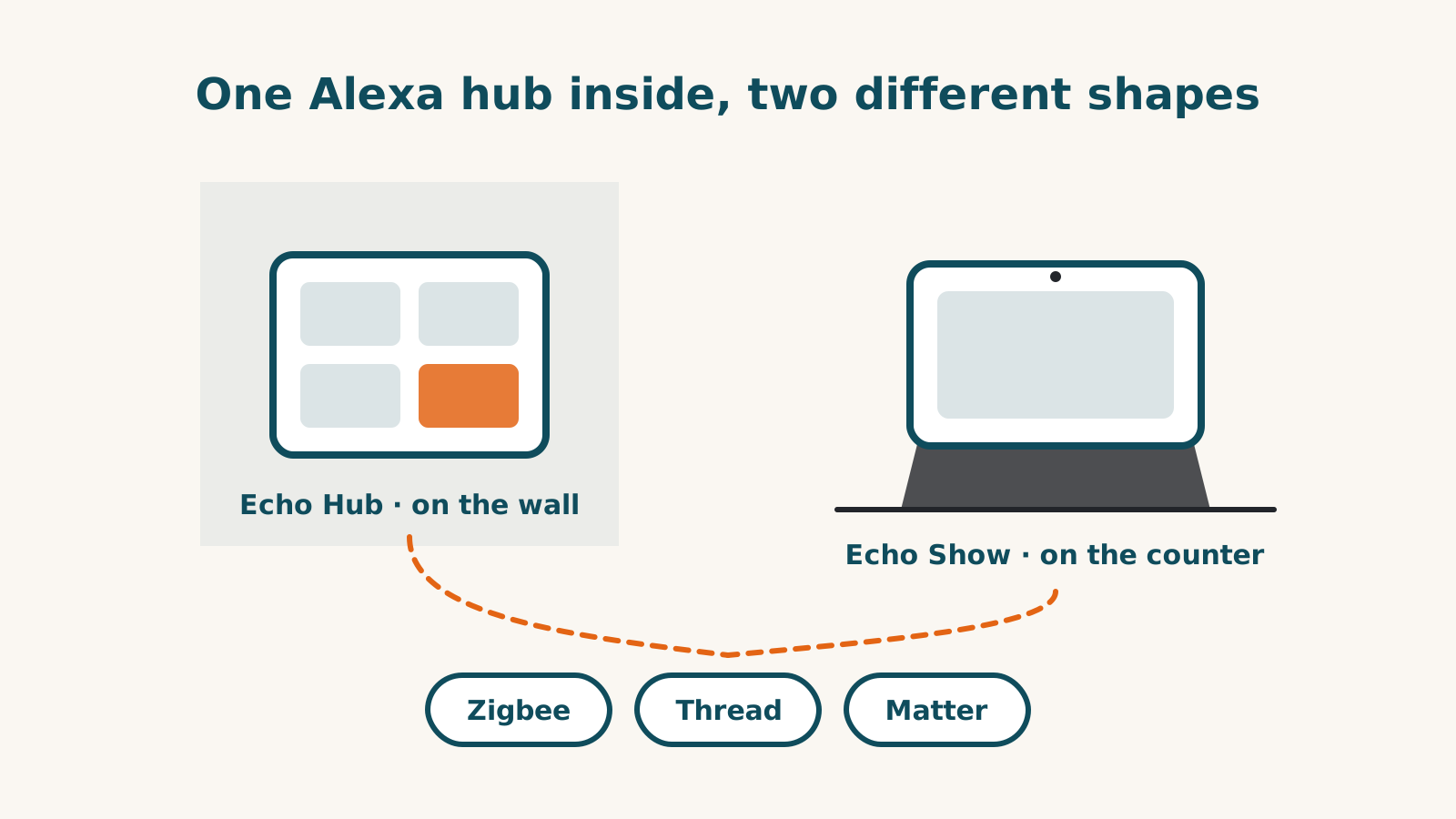
The Echo Hub is a control panel for the wall. The Echo Show 8 and Echo Show 11 are a screen and speaker for the counter that also run the smart home. The hub roles are the same on all three. The Echo Hub, the Echo Show 8 and the Echo Show 11 each have a built-in Zigbee hub. Each also acts as a Thread border router and adds Matter devices to Alexa. So the choice comes down to where the device will sit, whether a camera belongs in that room, and which generation a listing is selling.
What they share
None of the three can be added to Apple Home or Google Home. Each is an Alexa hub rather than a device other systems can pair with, and the Matter badge on the box means it can control Matter devices for Alexa, not that it can be controlled from elsewhere. If you later want a Matter light in Google Home or Apple Home as well, you share the light itself with that platform. The Echo won’t pass it along.
The evidence behind the radios isn’t identical. Amazon’s developer lists name the Echo Hub and the Echo Show 11 as Zigbee hubs and Thread border routers. For the Echo Show 8 we’re relying on Amazon’s launch announcement, which describes a “built-in smart home hub with support for Zigbee, Matter, and Thread” without the same detail.
Where they differ
The Echo Hub is a panel for the wall
Amazon announced the Echo Hub at $179.99, and that is not a live price. It’s built as an Alexa control panel, and two of the things that make it look tidy cost extra: the counter stand and the Power-over-Ethernet adapter are both sold separately.
Our record does not establish which Echo Hub features keep working without the internet. Check that separately if the panel will be your main way to control a room.
The Echo Shows are a screen that’s also the hub
The Echo Show 8 and Echo Show 11 described here are the 2025 models, at $179.99 and $219.99 in Amazon’s launch announcement. Amazon separates them by price and screen size only, and describes both as sharing the same display technology, the same 13-megapixel camera and the same speakers. A larger screen is the documented distinction here; this is not a finding from comparing the devices in use.
Both have that camera, so a Show is the wrong shape for a room where you’d rather not have one. On the Show 11 the camera is also part of how the device senses whether someone’s nearby: Amazon describes that presence sensing as combining the camera with audio, ultrasound, Wi-Fi radar, an accelerometer and Wi-Fi signal data.
One naming trap is worth knowing. “Echo Show 8” has covered several different devices over the years, and the one described here is the 2025 release, so check the generation on any listing before you buy.
What Alexa+ changes
Alexa+ is Amazon’s paid assistant tier. The recorded Alexa+ terms, checked on 16 September 2026, price it at “$19.99 per month” and says “all Amazon Prime members get it for free.” None of these three devices needs it. The Echo Hub, the Echo Show 8 and the Echo Show 11 all now answer the fee question the same way on our pages: the smart-home job runs without a plan.
What the plan changes is the conversation. Our records distinguish the optional advanced conversation features from the core smart-home functions. Check Amazon’s current plan terms for the particular feature you want; the plan information here is dated research.
What we can’t tell you is which features keep working when the internet drops. Amazon’s pages that we can read don’t say, for the Hub or for either Show.
If your home runs Alexa beside another platform
In a house split between Alexa and Google Home, Apple Home or SmartThings, an Echo stays on the Alexa side. None of those platforms can add the Echo Hub or either Show, so a Zigbee device paired to the Echo is reachable from Alexa only. Matter is the route across: a Matter device paired to the Echo can still be shared with the second platform on its own, without going through the Echo.
Home Assistant is a partial case. It lists the Echo Show among the devices its Alexa Devices integration supports, so it can play media on the Show 11, trigger Alexa routines, restart it and read its temperature and light sensors. It does not see the devices Alexa controls through the Echo. For the Echo Hub and the Show 8, no Home Assistant route is established either way.
Which one fits
- The Echo Hub fits an Alexa home that wants one panel on the wall instead of reaching for a phone. It does not bridge its paired Zigbee devices into another platform. A Matter device can be shared with another platform through its own pairing route. Budget for the stand or the Power-over-Ethernet adapter if you need either.
- The Echo Show 8 fits an Alexa household that wants one countertop device to be the screen, the speaker and the smart-home hub, without buying a separate bridge for Zigbee or a border router for Thread.
- The Echo Show 11 is the same idea with a larger screen. Its recorded hub roles, camera resolution and optional-plan status match the Show 8; the supporting evidence differs as described above.
- None of them suits a home that runs on Apple Home or Google Home. There’s no way in from either side.
If you’re still weighing Alexa against the other platforms, our ecosystem guide is the place to start, and the hub directory compares these with every other hub we cover.
Frequently asked questions
If I already own an Echo Show 8 or 11, do I need an Echo Hub for Zigbee or Thread devices?
No. Both Echo Shows already have a Zigbee hub and a Thread border router built in, so they can take those devices on their own. An Echo Hub would add a control panel on the wall, not a missing radio.
Sources for this guide· 3 product records
Product facts come from the linked research records; other cited sources appear below. Read each claim with its source date and any stated limit. Prices, features and support can change after a check. These are research profiles, not hands-on reviews.Report a correction if a source now gives a different answer.
- Amazon Echo Hub — record last verified 2026-09-22 · 26 sources, cited in full on its profile
- Amazon Echo Show 8 (2025 release) — record last verified 2026-08-18 · 20 sources, cited in full on its profile
- Amazon Echo Show 11 (2025) — record last verified 2026-10-03 · 45 sources, cited in full on its profile